Boeing’s Demolition of five Radioactive Area IV Buildings: 2026
Boeing’s Permits for demolition
“DTSC will ensure that the demolition and disposal of these buildings is carried out in accordance with applicable law…To facilitate a more conservative and quantitative analysis of impacts, DTSC is including the remaining Boeing building demolition as part of the analysis of project impacts.” PEIR, pdf page 37
Independent reports
“Demolition of Radioactive Structures and the Disposal and Recycling of the Debris from the SSFL Nuclear Area and the Role Played by the California Department of Toxic Substances Control and the California Department of Public Health,” Committee to Bridge the Gap, 2013
“Hunters Point Shipyard Cleanup Used Outdated and Grossly Non-Protective Cleanup Standards", Committee to Bridge the Gap, 2018 - use for comparison of Rad testing
“Boeing’s own submissions concede the structures exceed both background and the questionable “acceptable contamination” levels it tries to use.” CBG Disposal Study, PDF page 38
Studies/reports
2023 DTSC: Final Programmatic Environmental Impact Report (PEIR)
2017 DTSC: Draft Environmental Impact Report EIR
2013 Boeing: Demolition Work Plan for Building 4100 (Area IV)
2013 Lawsuit
In 2013, Committee to Bridge the Gap, Physicians for Social Responsibility - Los Angeles, and Consumer Watchdog sued the Department of Toxic Substances Control (DTSC) over Boeing’s Area IV Demolition of five radioactive buildings. DTSC and Boeing won.
“DTSC will ensure that the demolition and disposal of these buildings is carried out in accordance with applicable law…To facilitate a more conservative and quantitative analysis of impacts, DTSC is including the remaining Boeing building demolition as part of the analysis of project impacts. PEIR pdf page 37
“The demolition of the Area IV buildings was a private activity entirely within Boeing’s discretion and constituted activity that was not subject to discretionary approval by a public agency, and thus not subject to CEQA.” Final Ruling
“Although no prior authorization from DTSC is required for Boeing’s building demolition, DTSC analyzed this activity in the Final EIR as if it were part of the project in order to provide a conservative assessment of the impacts from the site cleanup.” Final Ruling
California regulation 17CCR§30256(k) (1)and (2) requires reasonable efforts to “eliminate residual radioactivity.”
Radioactive Do and do nots
Shouldn’t
old DPH documents (DECON-1 and IPM-88-2), which in turn reproduce a table found in an old AEC guidance document (REG Guide 1.86), decades old to create: The table is entitled “Acceptable Surface Contamination Levels,” except there is NO acceptable radioactive levels according to ALARA.
long-defunct Atomic Energy Commission’s Regulatory Guide 1.86
Boeing did not use the EPA’s background values, but instead obtained its own from other buildings within SSFL which may also be contaminated. This alone is sufficient to invalidate all of Boeing’s findings.
Should:
meet 17 CCR §30256(k)(2) regulatory standard of “eliminating residual radioactivity.”
EPA’s Preliminary Remediation Goal (PRG) calculators must be used
Building 4011
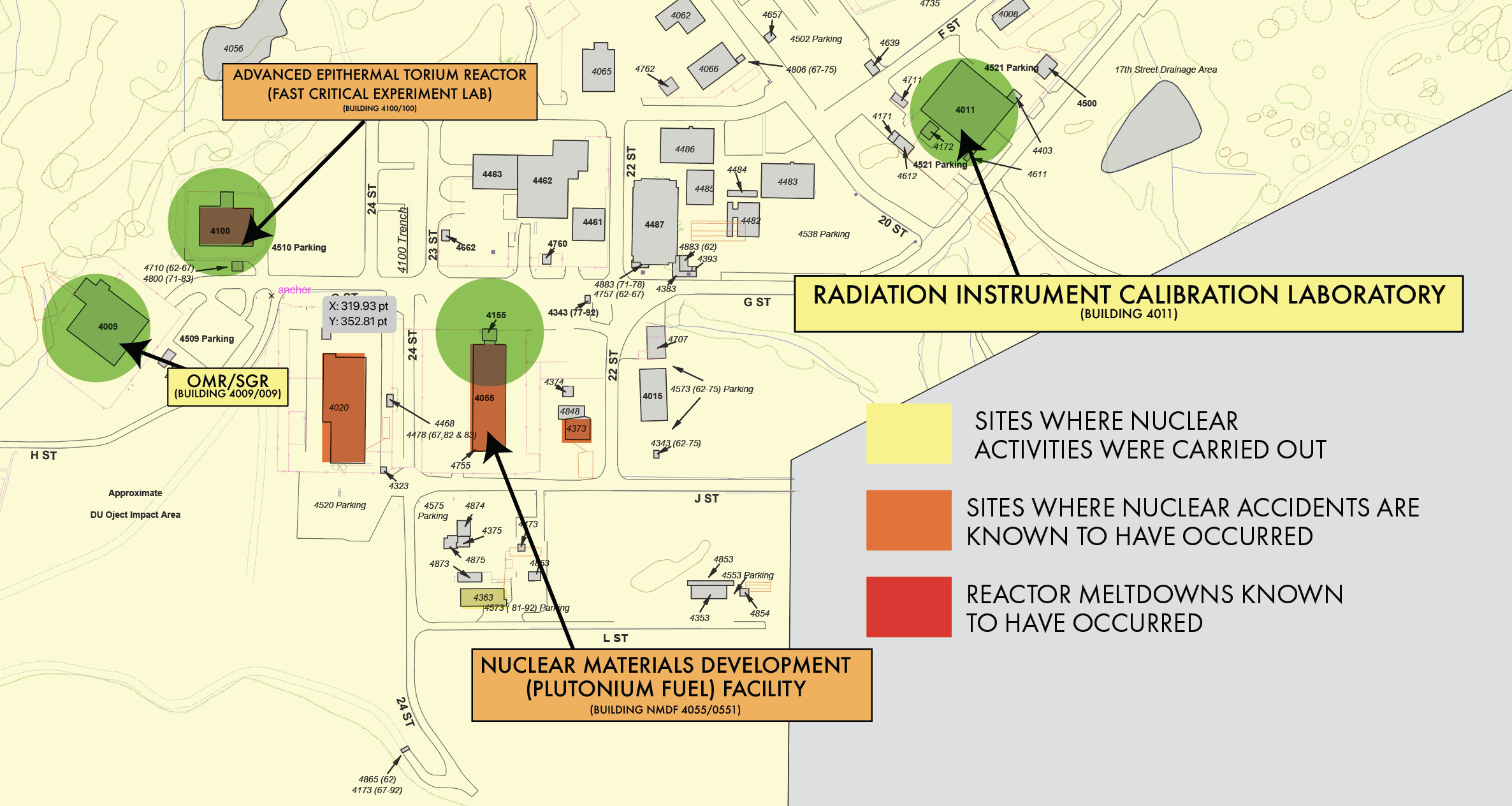
ADVANCED EPITHERMAL TORIUM REACTOR (FAST CRITICAL EXPERIMENT LAB)
Nuclear Accidents are known to have occurred at building 4011
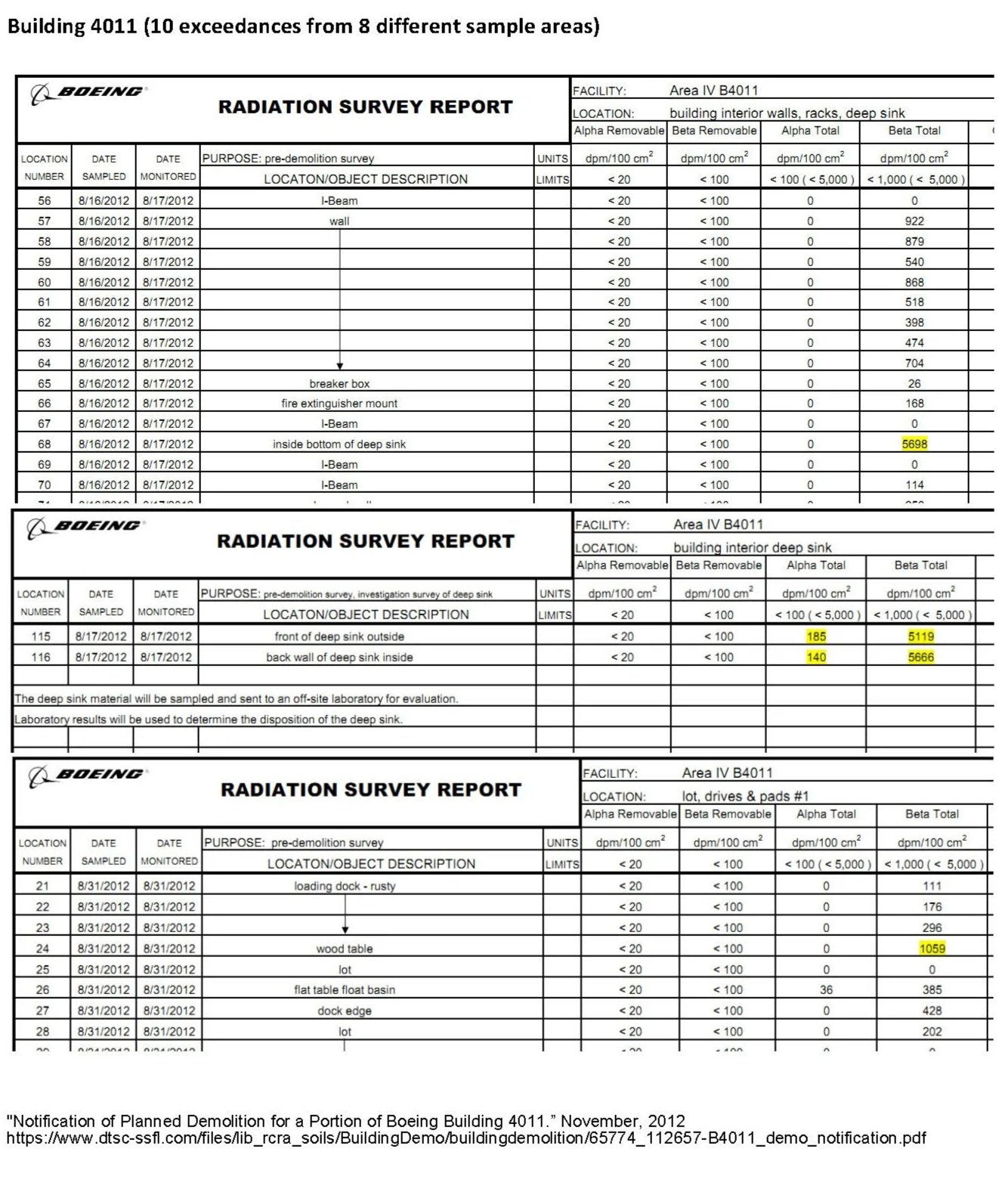
Over 10 “above background” radioactive detections were observed in EPA study
Documents:
Phase One: High Bay
Phase Two: Low Bay
Historical Information
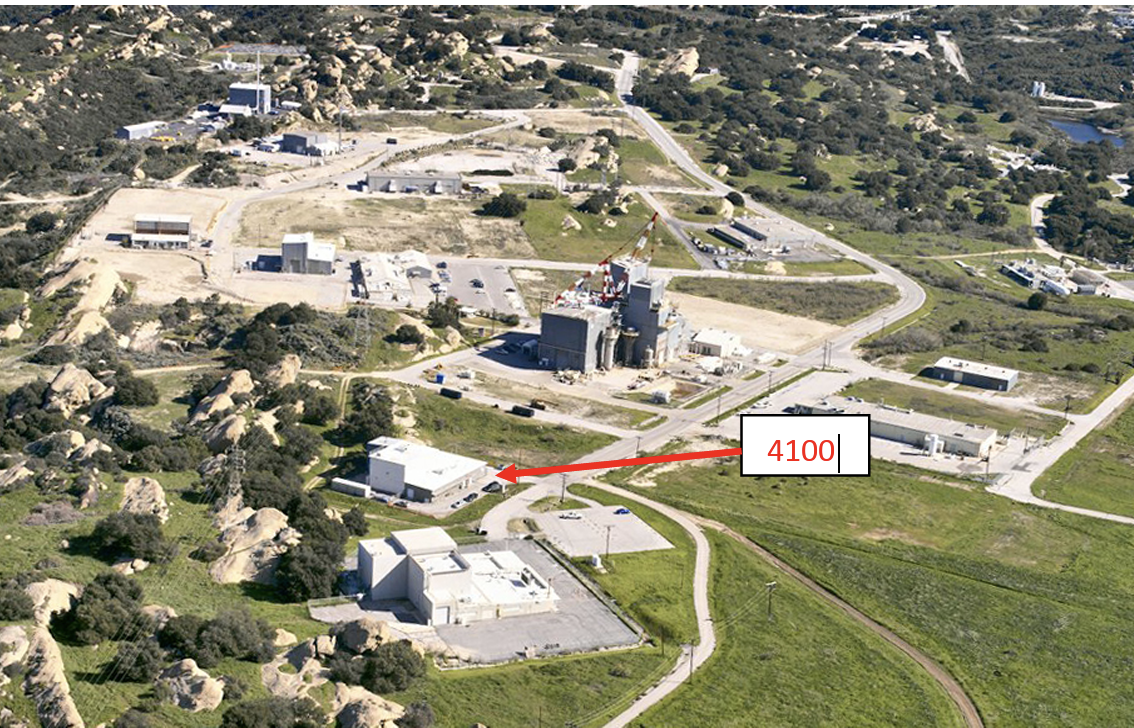
Building Features: Building 4100 contained an experimental critical assembly located within a high bay (Room 110), special nuclear material stored within a vault (Room 112), supporting rooms, and a control room (Room 109). The facility included a ventilation system with filtered exhaust for the high bay area, a storage vault, and laboratories. The low bay contained the Radiation Instrumentation Calibration Laboratory from 1984–1996
A pit adjacent to the facility contained a liquid holdup tank system for liquid wastes. Building 4100 also had a septic tank, a leach field, a trench outside the building, and two stacks, the higher of which reached 50 feet. Building 4100 currently houses one of the largest computed axial tomography (CT) scanners in the world.
Former Use(s): Building 4100 housed the Advanced Epithermal Thorium Reactor (AETR), which was a separable-half critical experiment operating at less than 200 watts (thermal), Fast Critical Experiment Laboratory (FCEL), and Radiation Safety and Computed Tomography Laboratory. Twenty reactor core configurations were studied including thorium, uranium, and later, high-energy fast neutrons in the FCEL.3 The FCEL operated until about 1974 under NRC License No. CX-17. The NRC terminated License No. CX-17, and released Building 4100 for unrestricted use in October 1980.4 From the late 1980s until 2008, the high bay was used for high energy Computer Aided Tomography (CAT). NASA owned the scanner. The laboratories were used for radioactive sample counting and instrument calibration.
Information from Interviewees: “ It did get “hot” in that room, the radioactivity was mostly due to the Uranium-233.”
Use in 2011: Used for office, laboratory, storage, and support activities. Small amounts of radioactive materials in samples and check sources are used in Building 4100.
Previous Radiological Investigation(s) and Decontamination/Cleanup of Release(s): A chronology of radiological investigations at this building is as follows: In 1980, Rockwell conducted a radiation survey to terminate facility license CX-17. All measured levels were below 1980 acceptable levels of 20 dpm/cm2 for alpha radiation and 50 dpm/cm2 for beta-gamma radiation.
Radionuclides of Concern: The Atomic Energy Commission issued in October 1960, Facility License No. CX-17 for Building 4100 and subsequently amended it to permit the use of U-233, U-234, U-235, U-236, U-238, Th-232, Np-237, Pu-238, Pu-239, Pu-240, and Pu-241 in the AETR and in January 1972 for use in the FCEL. Decay products would include Th-228, Ra-228, Th-230, Ra-226, Pb-210, Pa-231, and Ac-227.
Final Technical Memorandum: Area IV, Subarea HSA-5C PDF page 50 - 55
Timeline
1980 Rockwell Study (1)
1980 NRC conducted a radiation survey inside Building 4100 and confirmed Rockwell’s findings. (2)
1998 CDPH released Building 4011 for unrestricted use and removed it from Radioactive Materials License 0015-19
1999 Rockwell performed instrument surveys and soil sampling in the trench area.
2001 the EPA conducted a verification survey for alpha, beta, beta-gamma, and gamma radiation in accordance with the Multi-Agency Radiation Surveys and Site Investigation Manual (MARSSIM) guidance.
2012: DTSC and Boeing discuss demolition of High and Low Bay
Total detections :
10 above background
110 detections of radiological material
(1) Saba, V. B., Rockwell Internal Letter to Radiation Protection and Health Physics Services, re: Radiological Safety Report, Contaminated Respirator Laboratory Washer, December 17, 1991.
Building 4055 & 4155
NUCLEAR MATERIALS DEVELOPMENT (PLUTONIUM FUEL) FACILITY
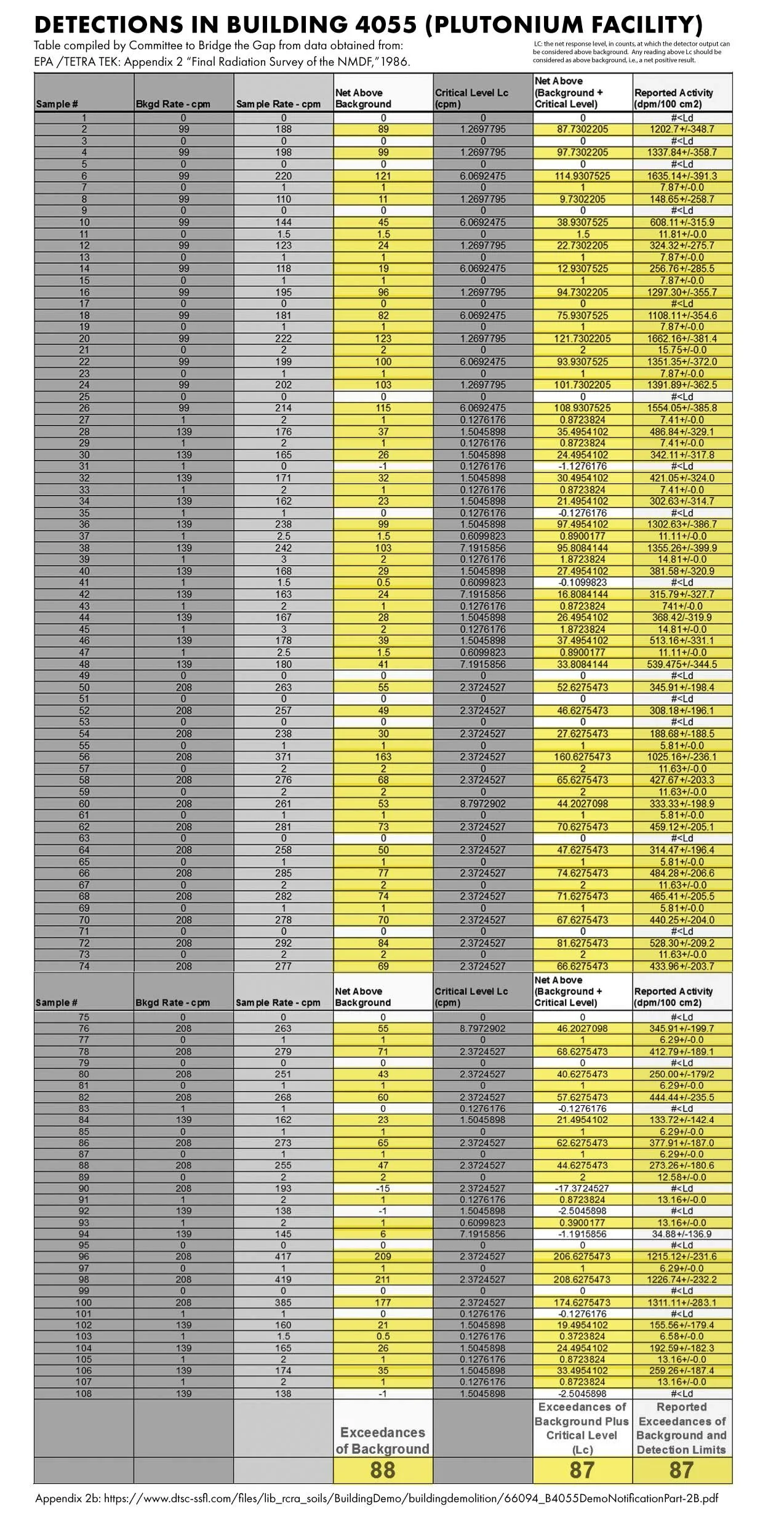
Nuclear Accidents are known to have occurred at building 4055
Over 88 “above background” radioactive detections were observed in EPA study
Documents:
Historical Information
Final Technical Memorandum: Area IV, Subarea HSA-5C PDF page 50 - 55
Timeline
1980 Rockwell Study (1)
1980 NRC conducted a radiation survey inside Building 4100 and confirmed Rockwell’s findings. (2)
1998 CDPH released Building 4011 for unrestricted use and removed it from Radioactive Materials License 0015-19
1999 Rockwell performed instrument surveys and soil sampling in the trench area.
2001 the EPA conducted a verification survey for alpha, beta, beta-gamma, and gamma radiation in accordance with the Multi-Agency Radiation Surveys and Site Investigation Manual (MARSSIM) guidance.
2012: DTSC and Boeing discuss demolition of High and Low Bay
Total detections:
88 above background detections