
Cleanup Scenarios
Reasonable people assume any toxic or radioactive site cleanup will remove all of the site’s dangerous contamination, but that’s almost never the case.
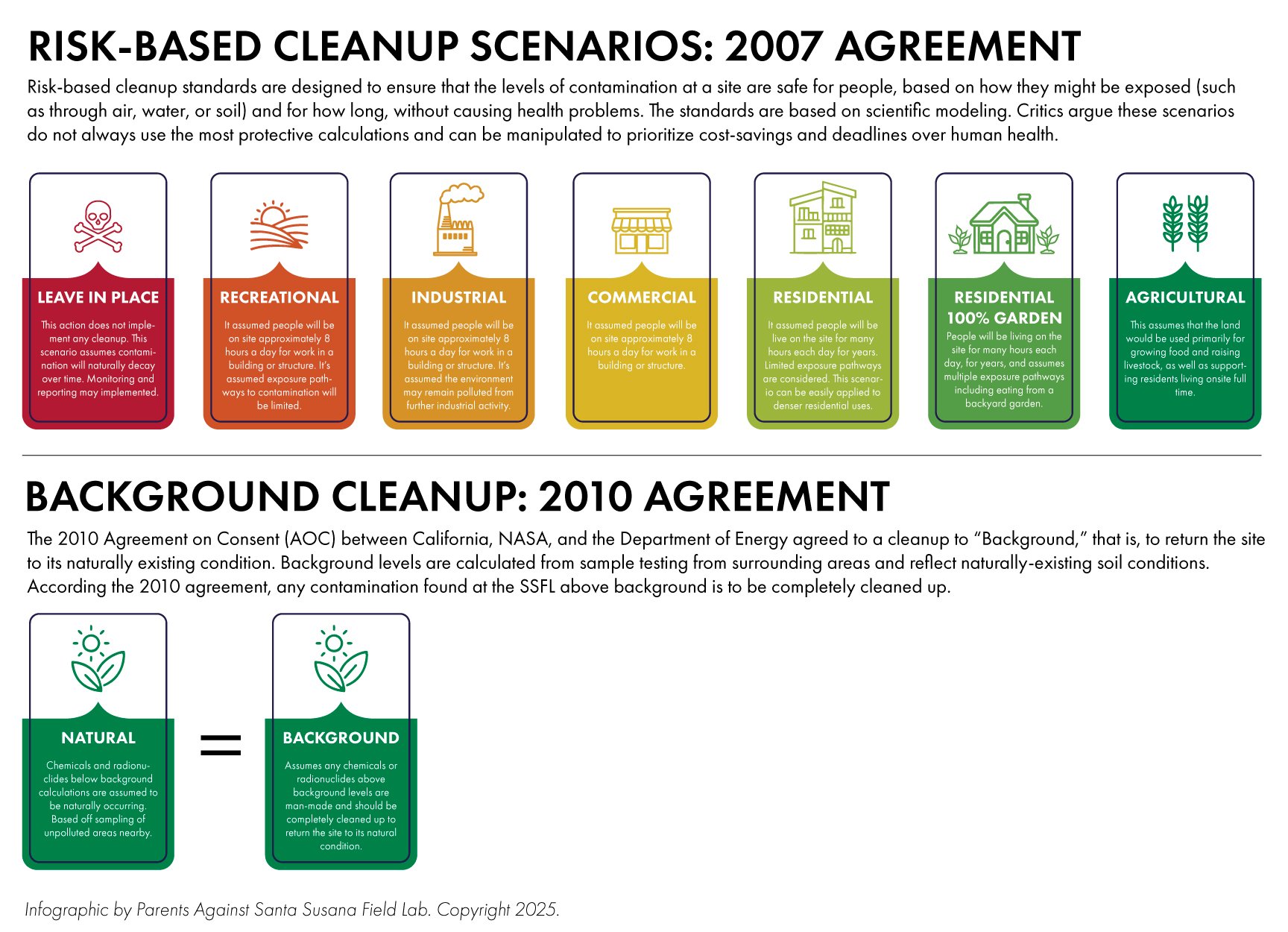
In 2007, the California EPA signed agreements with the Santa Susana Field Lab’s Responsible Parties (Boeing, NASA, and the Department of Energy) for a risk-based cleanup, based on the surrounding land-use zoning which included agriculture and residential with backyard gardens.
The 2007 agreement was made in good faith that state agencies would require the strictest risk-based mandates to remove all toxic and radioactive contamination.
In 2009 it became obvious that the Department of Toxic Substances Control (DTSC) would allow the Responsible Parties to use the weakest standards. SB 990 was passed to require a more stringent cleanup. Boeing sued and won on a legal default.
In 2009, the Department of Energy and NASA signed cleanup agreements to remove all man-made contamination onsite, known as a “background” cleanup. Boeing refused to sign.
The purpose of the Background Cleanup Agreement was to protect human health and the environment as its primary goal, and to simplify the process by limiting polluter’s manipulations; if it a constituent is determined to be man-made, it is remediated. Background cleanups are always the most protective cleanups and therefore the most expensive to implement, which is why Boeing, NASA and the Department of Energy do not want to comply.
All three Responsible Parties have taken actions to reduce their cleanup obligations, despite the known risks to public health and the environment.
Risk-Based Cleanup Loopholes
Risk-based loopholes are null and void under a background cleanup methodology, which is based on physical sampling. If the sampled constituents are determined to be man made, the polluter must remediate it.
Exposure Pathways
A risk-based cleanup rests heavily on exposure pathways, or how the site’s contamination will reach people - for example, drinking water is an exposure pathway. If the argument can be made that people won’t be exposed through a particular exposure pathway, the polluter can use this to justify leaving contamination onsite.
Rarely include risks from emergency use or natural disasters.
Relies heavily on current land use assumptions.
Often ignores offsite exposure pathways, even if the polluter’s contamination directly impacts them.
Boeing claims that because the SSFL groundwater isn’t used for drinking water, it can be left contaminated.
Land Use
Land use is a primary factor in risk-based cleanup calculations. If polluters can make the argument that the land won’t be used in ways that include higher-risk exposure pathways, such as farming, they can leave more contamination behind.
Is not often required to consider land use outside of their property lines, even if the polluter’s contamination directly impacts it.
Boeing donated its land to an easement to prevent people from living there and to secure a lesser “recreation” cleanup standard.
Does not account for changes to land use in the future, emergency use, or natural disasters.
Maximum Contaminant Levels (MCLs)
Instead of using the safest Public Health Goals, polluters are allowed to use maximum contaminant levels (MCLs) that have balanced known public health harm with “reasonable costs” to polluters and are significantly less protective.
MCLs can be used even if they are outdated and are contradicted by modern research.
MCLs can be influenced by those who have financial motives, such as polluters.
MCLs don’t always protect the most vulnerable populations.
Complicated Formulas
Risk-based cleanups use math-and-science-heavy formulas and calculations to determine what “health protective” means. Because these calculations and formulas are dense, polluters can “accidentally” miscalculate risks and change formulas without being caught by agency and
Boeing changed Risk Based Screening Levels in their cleanup documents which dramatically increased the amount of contamination they could leave while still labeling their work a “health protective cleanup.”
Modeling
Polluters can use modeling, even when data is physically available, to avoid making precise predictions about the site’s risks to the public and environment. The process opaque and it is difficult to determine if it was done properly.
Boeing has proposed to use modeling after their cleanup to determine if the site’s contamination is still polluting the LA River, instead of taking actual samples.